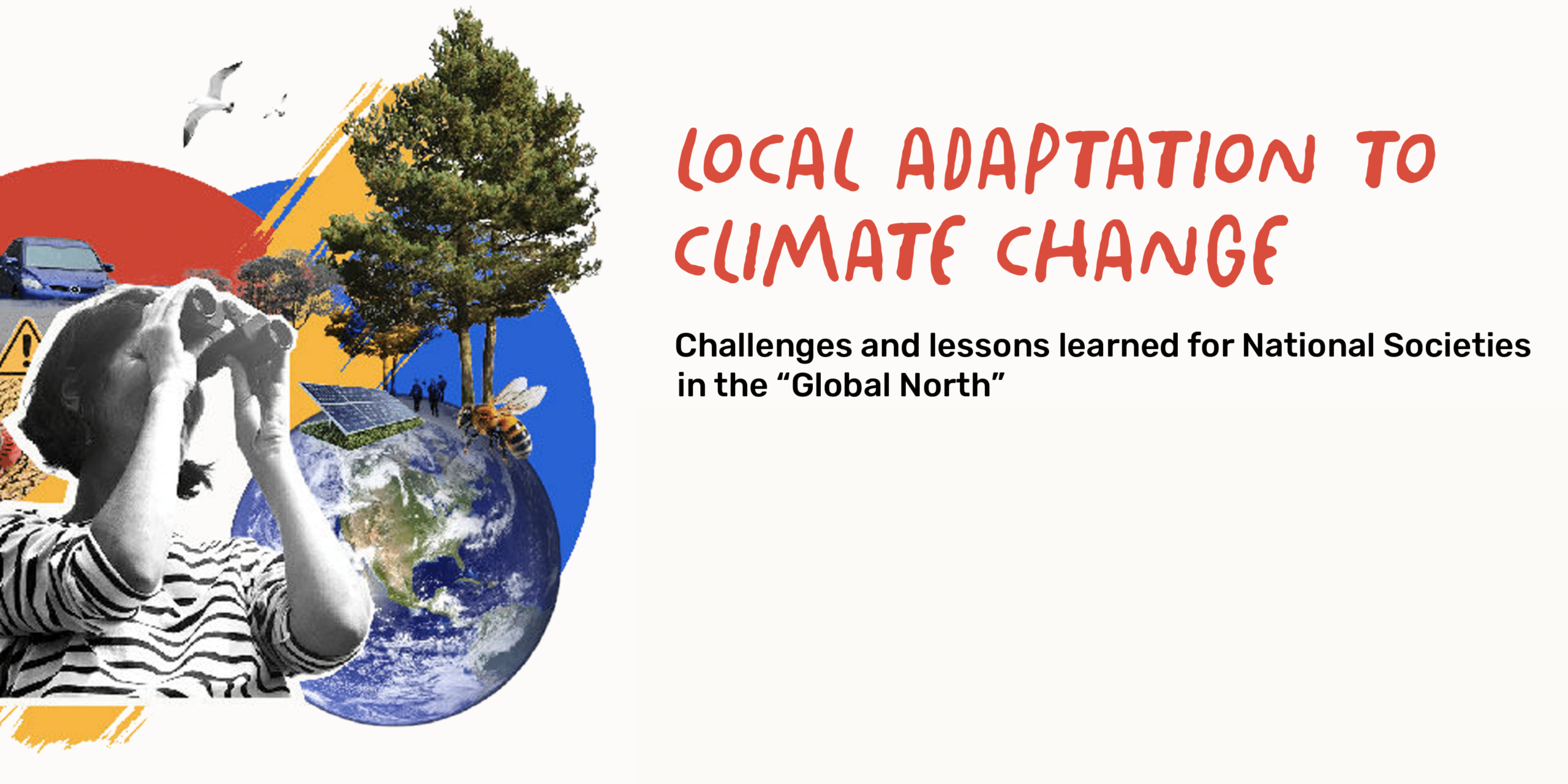
This Red Social Innovation publication, led by the French and Spanish Red Cross, aims to ‘‘demystify’’ the subject of local climate change adaptation by equipping innovators with the knowledge and tools they need to understand and act.
The first part begins by exploring the key definitions and issues involved in transposing the LLA (Locally Led Adaptation) approach to the context of “Global North” countries. The second part offers a range of case studies and tools drawn from existing initiatives within the Red Cross Red Crescent Movement, providing practical inspiration for readers. Finally, the third part invites reflection and opens up broader perspectives on the strategic role that National Societies can play.
In recent years, several extreme climate events have struck European territories, most notably the flooding in Valencia in October 2024, the cyclone that devastated Mayotte in December 2024, and the heatwaves and wildfires that swept across the Iberian Peninsula in the summer of 2025 each mobilizing emergency response operations by the Spanish Red Cross and the French Red Cross respectively. Lessons learned from these crises have highlighted both the remarkable capacity for rapid mobilization within our Movement, and the urgent need to strengthen our preparedness in the face of climate-related emergencies that are becoming increasingly frequent and severe across Europe.
These events raised a simple but pressing question: how could climate change adaptation (CCA) be more systematically embedded into our own national programmes?
Within the International Red Cross and Red Crescent Movement (RCRC), both mitigation and adaptation to climate change are already recognized as strategic priorities. However, existing work has largely been developed for ”Global South” contexts, where climate impacts have long shaped humanitarian action.
Today, a different question deserves to be asked: how can we draw on what works, and thoughtfully adapt it to our own realities? National Societies already have a rich set of tools, methods, and expertise at their disposal: participatory risk assessment, community preparedness, anticipatory action, and the documentation and sharing of local knowledge. These are approaches that have been developed, tested, and proven effective, yet they remain largely underutilized within the national contexts of “Global North” countries. At a time when the need for adaptation and mitigation is accelerating, innovation does not necessarily mean building new programs or developing new areas of expertise. It can also mean finding new ways to mobilize what already exists.
This is precisely the approach proposed here. Rather than treating climate change adaptation as ‘‘yet another programme,’’ ‘‘yet another cost,’’ or ‘‘yet another area of expertise,’’ this approach invites us to explore how the resources and know-how already present within the RCRC Movement can be repurposed, adapted, and shared to address the climate challenges now affecting every region and community. Because innovation is not solely about invention. It is also about the capacity to shift perspective. And sometimes, that begins with a simple question: what can we learn from ourselves?
If you want to know more