Description
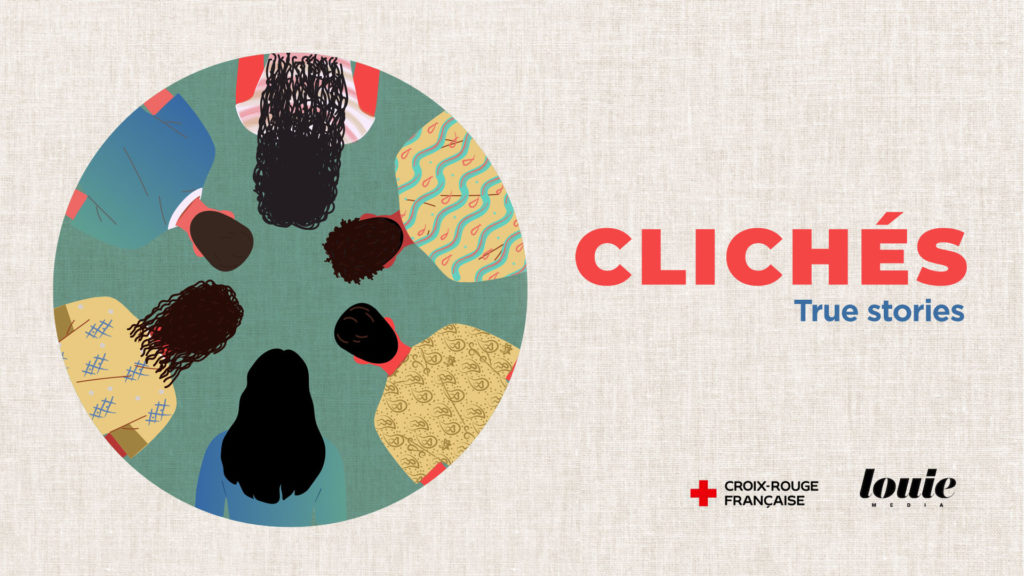
True Stories is a one-year Erasmus+ project that brings together the French Red Cross, Louie Media, Open Cultural Center Spain, and Open Cultural Center Greece. It combines the co-creation of the 5th season of the podcast Clichés, featuring the voices of people with lived experiences of migration, with a set of local media training sessions and a multilingual social media campaign (#TrueStories).
The project focuses on the voices of refugees and migrants as producers, not subjects, of the stories that shape public perception.
Context
Refugees and migrants are often spoken about, rather than listened to. Their stories are filtered, reduced to legal or political status, and rarely reflect the complexity and resilience of their lived experiences.
In this context, True Stories was born from a need to rebalance the public narrative: to equip migrant and refugee individuals with storytelling skills and media literacy so they can take ownership of their image and contribute to shifting public perception – locally and across Europe.
Technical details & Operations
True Stories unfolded through three main activities.
First, the co-creation of the podcast season, led by Louie Media. Six audio episodes were recorded with participants from France, Spain, and Greece. Each episode was also adapted into a video version, with subtitles in French, English, Spanish, and Greek to ensure accessibility. A dedicated “making-of” episode documented the behind-the-scenes process and highlighted the experience of the participants, offering insight into how the stories were shaped and shared.
Second, media training sessions were coordinated by the French Red Cross. Three local sessions took place in Polykastro, Paris, and Barcelona, bringing together 15 participants. Each training followed a participatory approach. Participants explored media literacy topics such as tone, scriptwriting, and ethics. They also learned practical audio and video techniques, including sound recording, framing, lighting, and how to use smartphones and basic equipment effectively.
The sessions emphasized practice-based learning: participants tested microphones, recorded short pieces, and rehearsed interviews. A reverse pedagogy approach was also used, allowing journalists to learn from participants about sensitive questions, representation, and how to build trust. Each participant received a certificate of participation.
To extend the project’s impact, a Media Guide was created to support migrant-led collectives in sharing their stories online. In addition, a Trainer Framework was developed to help organizations replicate the training, with guidance on structure, language support, ethical considerations, and co-learning methods.
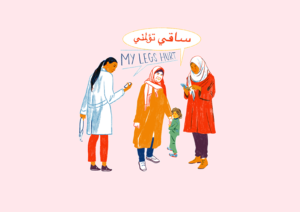
Third, the #TrueStories social media campaign was led by Open Cultural Center Spain. Content was shared across TikTok, Instagram, LinkedIn, and Spotify, with the support of social media ambassadors. A press conference was organized in Paris on International Migrants Day, December 18, 2024. Communication materials included visuals and multilingual subtitles co-created with an illustrator from a migrant background, ensuring authenticity and accessibility.
Deployment & Impact
More than 7,000 people listened to the 5th season of Clichés across different platforms, demonstrating a strong public interest in first-hand narratives about migration. The content was produced in four languages and adapted for both podcast platforms and social media, ensuring accessibility and cross-border reach.
The project also had a direct impact on participants. A total of 15 refugees and migrants, across three countries, completed the media training programme. Beyond technical skills, participants reported increased confidence, stronger media literacy, and a greater ability to shape and share their own stories. The reverse learning approach also helped media professionals reflect on their practices and build more ethical, trust-based storytelling methods.
To ensure sustainability, two open-source resources were made available through Red Social Innovation: the Media Guide, designed for individuals and migrant-led collectives wishing to share their stories online, and the Trainer Framework, developed to help institutions and non-governmental organizations replicate the training methodology.