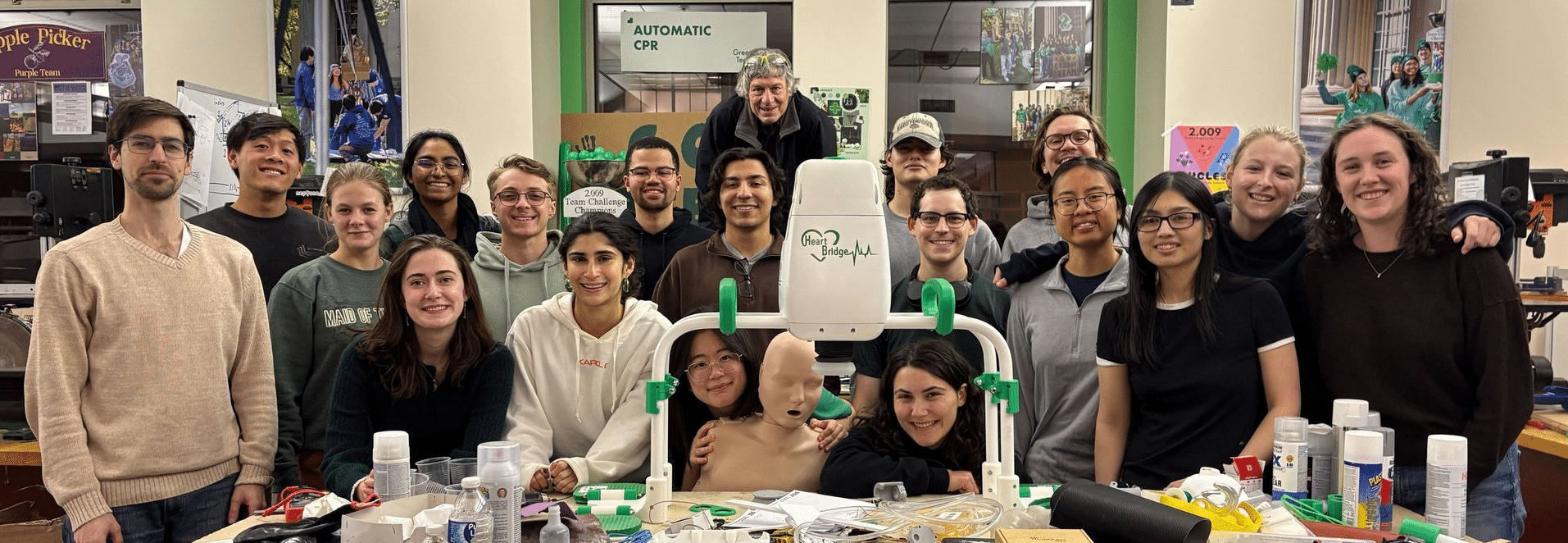
Saving a life shouldn’t depend on physical strength, medical training or the confidence to perform CPR perfectly under pressure. HeartBridge is exploring how technology could make effective CPR more accessible to the people already there when every minute matters.
When a person suffers cardiac arrest, every minute matters. Without immediate cardiopulmonary resuscitation (CPR), their chances of survival decrease rapidly while waiting for professional medical care.¹ Research has consistently shown that early bystander CPR can significantly improve survival,² yet many people hesitate to intervene or struggle to maintain effective chest compressions at the recommended rate of 120 compressions per minute and a depth of 5 cm until emergency responders arrive.³
The inaction is understandable. CPR is physically demanding, especially over several minutes. Many people worry they have forgotten their training or are afraid of doing something wrong. Even trained responders experience fatigue, and the quality of chest compressions decreases over time.
These realities raise an important question: how can people feel more confident stepping forward to help?
Designing CPR technology for bystanders
This inspired HeartBridge, an MIT spin-out, to develop a mechanical CPR device designed to support bystanders during cardiac arrest emergencies.
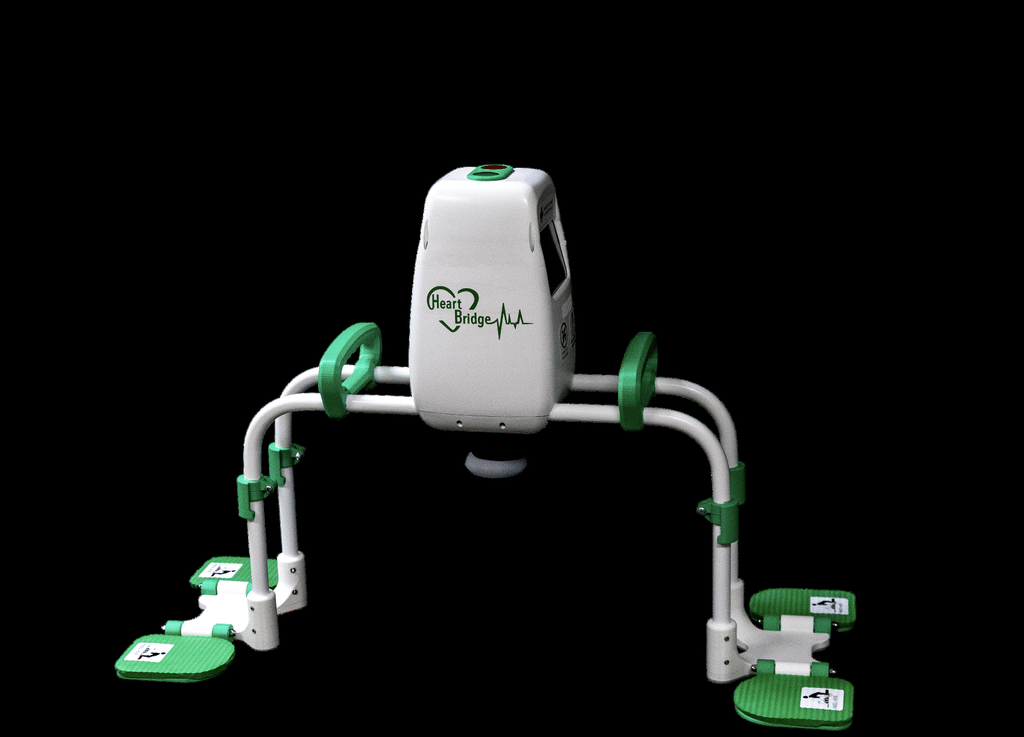
While mechanical CPR devices are already being used in hospitals and ambulances, they require extensive training to be used effectively. HeartBridge is designed for bystanders, with on-screen instructions intended to make it intuitive to deploy for non-professionals and everyday bystanders.
Although still in the developmental phase, HeartBridge will ultimately be a complete resuscitation device, with connectivity to an automated external defibrillator (AED). While compressions ensure that blood continues to circulate around the body, an AED analyses the heart rhythm and, when appropriate, delivers an electric shock. Both can play a critical role in cardiac arrest response, and HeartBridge aims to streamline them into one setup.
From campuses to communities
One of the most exciting aspects of this approach is its adaptability. The same device that could support a student responding to a classmate on a university campus could also assist a passenger on public transport, or a spectator at a sporting event.
In rural communities, where emergency services may take longer to arrive, maintaining effective CPR becomes even more important. HeartBridge aims to help bystanders sustain lifesaving care during the longer wait that may occur before emergency medical teams arrive in remote locations.
Following natural disasters or humanitarian crises, where healthcare systems may be overwhelmed or access to care disrupted, technologies that help sustain effective bystander response could provide an additional layer of support for affected communities.
Lowering the barriers to lifesaving action
This potential points to a broader social impact: making lifesaving action more accessible.
If technology can reduce the physical and psychological barriers that prevent people from performing CPR, more bystanders can be empowered to step forward rather than waiting for someone else to act.
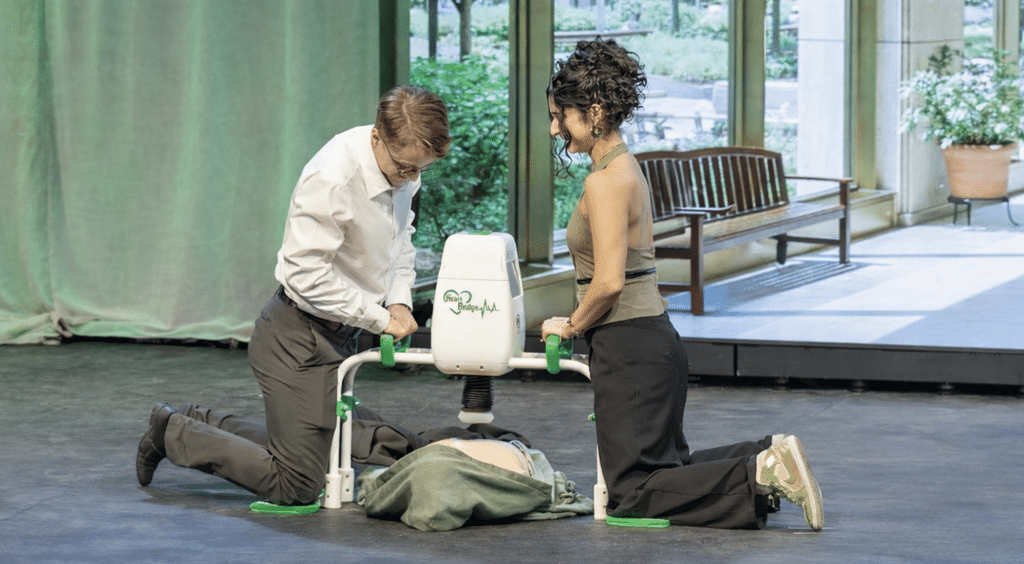
For organizations that promote cardiac awareness, this could complement existing first-aid training, community preparedness and local response capacity. Rather than replacing trained responders, a device like HeartBridge could extend their impact by helping communities provide more effective assistance while professional care is still on its way.
This is also where the innovative value of HeartBridge goes beyond the device itself. Mechanical CPR technology already exists. The project is exploring whether technology traditionally used by trained professionals can be redesigned around the needs, constraints and confidence of ordinary bystanders.
Technology alongside existing expertise
Technology cannot replace the judgment, training and local knowledge of experienced responders. Instead, HeartBridge aims to develop technology that enables bystanders to support these existing forms of expertise.
In emergency settings, innovation is most valuable when it works alongside established systems, helping people apply their skills more effectively and lowering barriers for those who may otherwise hesitate to act.
In emergency settings, innovation is most valuable when it works alongside established systems.
Ultimately, lifesaving should not depend solely on who is nearby, how physically capable they are or how confident they feel in an emergency.
Technology should support existing infrastructure and expertise while expanding who can participate in lifesaving efforts. By giving more bystanders the confidence and ability to provide effective CPR for longer periods, technologies like HeartBridge could strengthen the first response to cardiac emergencies and, ultimately, help more people make it home to their families.
Find out more
References
- [1] Dobbie, Fiona, Anne Marie MacKintosh, Gareth Clegg, Rebecca Stirzaker, and Linda Bauld. “Attitudes towards Bystander Cardiopulmonary Resuscitation: Results from a Cross-Sectional General Population Survey.” PLoS ONE 13, no. 3 (2018): e0193391. https://doi.org/10.1371/journal.pone.0193391
- [2] Merchant, Raina M., Alexis A. Topjian, Ashish R. Panchal, et al. “Part 1: Executive Summary: 2020 American Heart Association Guidelines for Cardiopulmonary Resuscitation and Emergency Cardiovascular Care.” Circulation 142, no. 16_suppl_2 (2020): S337–57. https://doi.org/10.1161/CIR.0000000000000918
- [3] Olasveengen, Theresa M., Federico Semeraro, Giuseppe Ristagno, et al. “European Resuscitation Council Guidelines 2021: Basic Life Support.” Resuscitation 161 (April 2021): 98–114. https://doi.org/10.1016/j.resuscitation.2021.02.009


