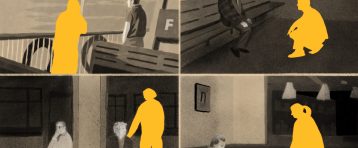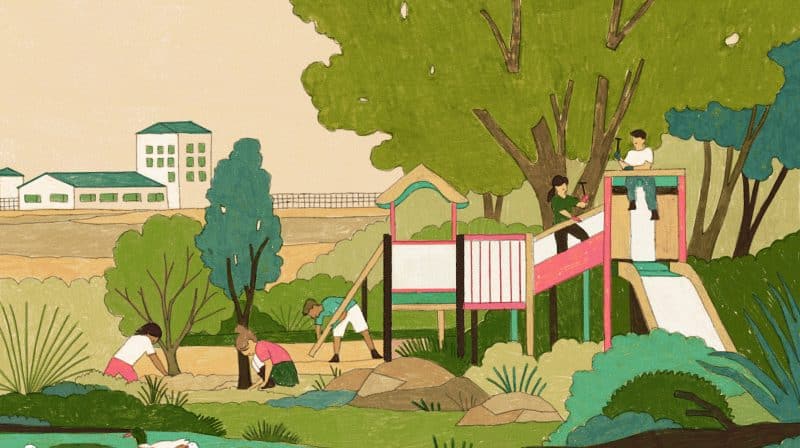
A participatory urban experimentation process that transforms schoolyards and their surroundings into climate-social oases, co-designed with children, families, educators, city departments and local organizations to strengthen climate resilience, social cohesion and child well-being.
Context
Cities across Europe are facing two converging pressures: intensifying heatwaves and growing social inequalities. Children—especially in low-income districts—are among the most exposed to climate risks and the least represented in decision-making. In Madrid’s neighbourhood of San Cristóbal (Villaverde), schools like CEIP Sagunto and CEIP Navas de Tolosa experience extreme summer temperatures, limited vegetation, impermeable surfaces, and surrounding public spaces that often reinforce isolation or insecurity.
Before LIFE PACT, school environments were typically designed as flat, asphalted courtyards with limited shade and few opportunities for play diversity or contact with nature. Local families valued these spaces but had little influence over their design. Municipal departments were aware of the problem yet lacked mechanisms to coordinate efforts or to meaningfully integrate community knowledge—especially that of children—into climate adaptation strategies.
The LIFE PACT solution responds to three interconnected needs:
Climate adaptation in vulnerable neighbourhoods.
Madrid’s heat-vulnerability studies show that San Cristóbal experiences some of the highest risks in the city. Greening, shade, and water-based microclimate solutions are urgent.
Strengthening social cohesion and sense of belonging
The neighbourhood has a rich cultural diversity, yet limited interaction among families, linguistic barriers, and a persistent feeling of stigma and insecurity. Schools offer a shared and trusted public space to rebuild community connections.
New governance models for urban transformation
Traditional planning tools were not sufficient to address the complexity of climate adaptation at a neighbourhood scale. The city needed a process capable of integrating science, community knowledge, creativity, and cross-department collaboration
LIFE PACT in Madrid provides this missing framework. Through an iterative process of listening, co-creation, prototyping and implementation, the project uncovers the lived experiences of children, tests new ideas, and aligns them with municipal policies. As a result, the transformation is not only physical but cultural—schools become climate refuges, social meeting points, and drivers of neighbourhood regeneration.
Operations
The LIFE PACT process works through six iterative and transversal stages, blending technical methods with creative, educational and participatory tools. Throughout the process, multidisciplinary teams (municipal departments, NGOS, research groups) collaborate to ensure scientific accuracy, community alignment and long-term maintenance solutions.
- Active Listening (Escucha Activa):Teams conduct fieldwork, interviews, observation sessions, microclimate measurements and narrative mapping with children, teachers, families, health services and community organizations.
- Co-creation Workshops: Artists, educators, philosophers, architects and facilitators run hands-on sessions with children and teachers. These methods democratize design and stimulate collective imagination: “Patio Portrait” (emotional mapping of the playground); “Fantastic Pairs” (creative storytelling); “Scientists for a Day” (using environmental sensors); “Utopia is Possible” (physical model prototyping); “Playing the Future” (testing spatial ideas through theatre and gameplay).
- Prototyping: Promising ideas are turned into low-cost prototypes to test spatial layouts, shade structures, natural features, or new uses. Iterations help identify what works before committing to infrastructure.
- Technical Design and Engineering: Architects (equipo.exe and Basurama) translate community proposals into technical plans, aligned with municipal guidelines such as permeable pavements; biodiverse planting; shade systems; water retention features; safe and inclusive access routes.
- Construction: The city implements phased construction. In 2024, the first phase at CEIP Navas de Tolosa was completed, integrating soil permeability, new plantings and connections to the adjacent park. Next stages are programmed to be finalized in Q1 2027.
- Evolutionary Communication and Evaluation: Communication is treated as a co-creation tool rather than one-way outreach. Community events—such as “Este patio es un mundo”—gather hundreds of residents, building collective ownership.
Funding
The Madrid pilot is funded through: EU LIFE Programme (LIFE20 CCA/BE/001710); Madrid City Council, particularly the Directorate-General for Energy and Climate Change; In-kind support from NGOs, research centres and local partners. The project is non-profit and does not generate revenue. Its “business model” is public value creation: climate resilience, public health, child well-being, community strengthening, and improved urban governance.
Deployment & Impact
The deployment of LIFE PACT Madrid unfolded not as a conventional urban project, but as a story of collective transformation—one that began in the classrooms and courtyards of two public schools in San Cristóbal, one of Madrid’s most climate-vulnerable and socially diverse neighbourhoods. Rather than imposing a predefined plan, the process started with months of active listening, walking the streets with local associations, sitting in classrooms with children, observing playground dynamics, and mapping microclimatic vulnerabilities with environmental researchers. This early immersion created a shared understanding of the neighbourhood’s challenges: extreme heat, scarce shade, impermeable surfaces, low biodiversity, and an underlying sense of spatial isolation.
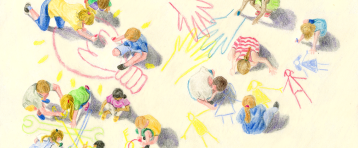
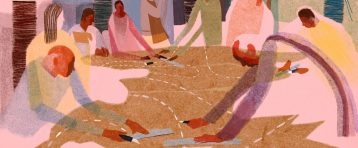
From this foundation, the project moved into co-creation, transforming the schools into temporary laboratories of imagination. Children painted emotional maps the size of basketball courts, acted out future playgrounds in improvised theatre pieces, and built prototype models from recycled materials. These creative exercises were not side activities; they became the blueprint for the design.
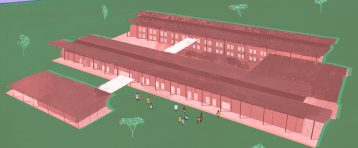
The insights gathered from these sessions were carried into the technical design phase, where architects and municipal teams worked side-by-side, translating children’s ideas into feasible interventions. The first major visible milestone arrived in 2024 with the construction of Phase 1 at CEIP Navas de Tolosa: the replacement of asphalt with permeable soils, the creation of shaded resting areas, the integration of vegetation, and—perhaps most symbolically—the opening of the schoolyard to the adjacent park, reconnecting the school with its natural surroundings.
The children started seeing the school as something they could shape, not just inhabit.
The impact of these interventions became immediately tangible. Teachers reported that children gravitated naturally toward the cooler, greener areas. Families began lingering at the school gate, finding new spaces for informal interaction. During heatwaves, surface temperature measurements registered 2°C to 5°C reductions in the newly naturalized zones.
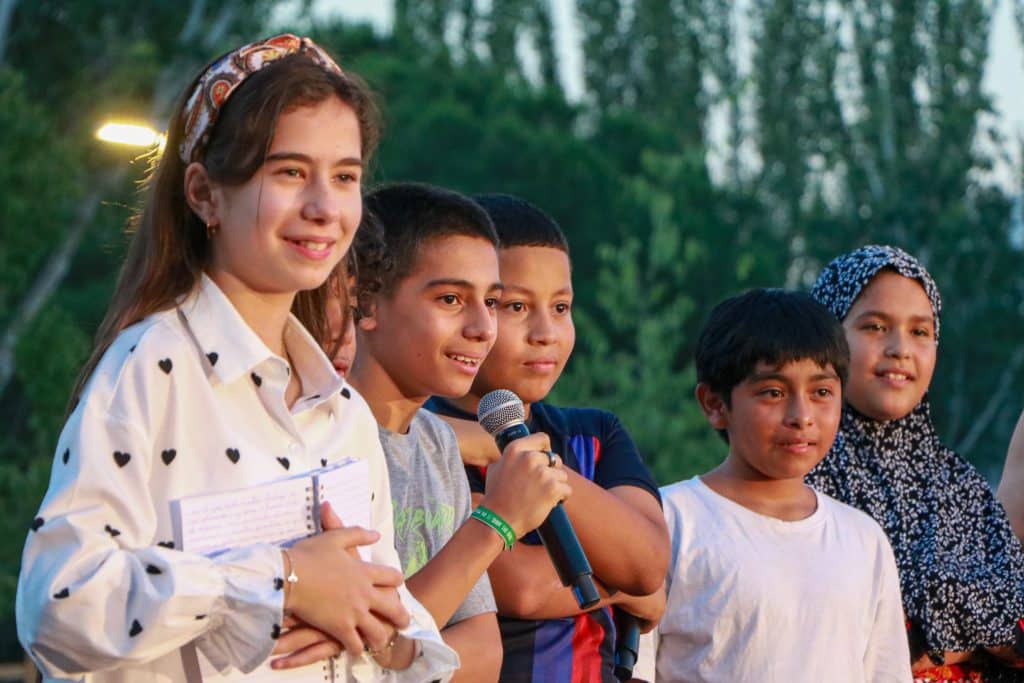
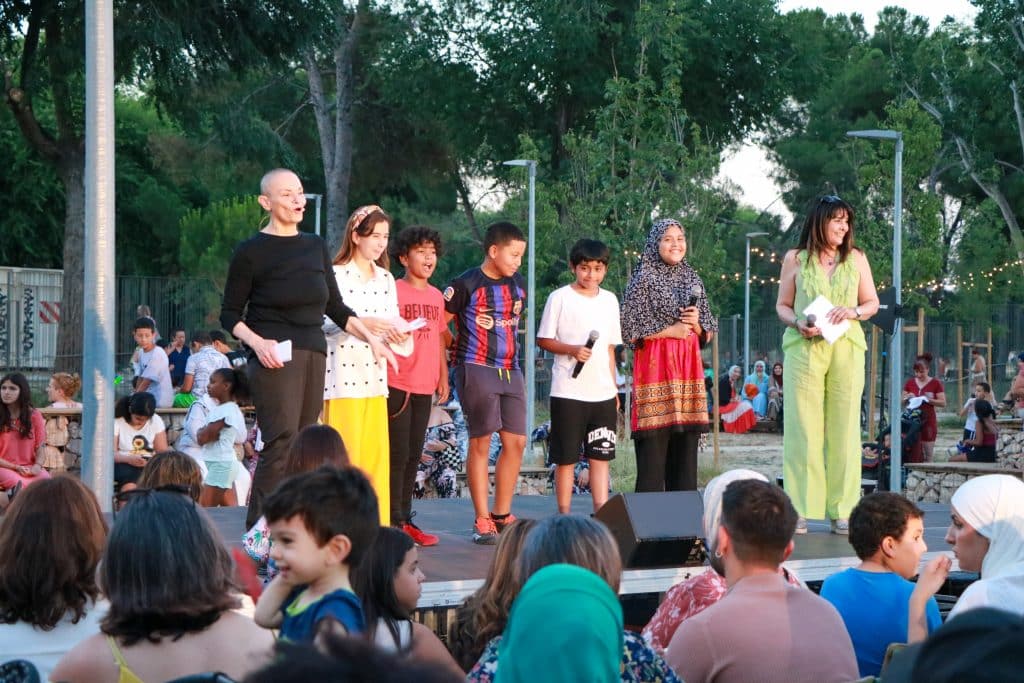
But the deepest impact may be the social transformation. In July 2024, more than 600 neighbours gathered for “Este patio es un mundo,” a community celebration inside the newly transformed schoolyard. The event brought together families of over twenty nationalities, municipal workers, local associations, and children proudly guiding visitors through “their” oasis. For many residents, it was the first time they saw the space not just as a playground, but as a shared urban commons.
The project has also reshaped municipal practice. The methods tested here informed the new municipal schoolyard renaturalization guidelines, now used across Madrid to guide future climate-adaptation projects. What began as two school pilots is evolving into a scalable model, proving that when climate action is rooted in participation, imagination, and care, it can transform not only physical spaces but also the social fabric that sustains them.
Key figures
2 schools
involved in the pilot
600+
residents engaged in community events
2-5°C
projected cooling
Partners and stakeholders
- Madrid City Council – Leadership, funding, technical teams
- Universidad Politécnica de Madrid (itdUPM) – Orchestration, Research, coordination, evaluation
- Basurama – Participatory design, workshops, conceptualization, and Architectural design.
- Equipo.exe – Architectural design.
- Democratic Society – Governance and community engagement.
- Dark Matter Labs – Systems innovation and urban adaptation.
- Local schools (CEIP Sagunto, CEIP Navas de Tolosa) – Educational collaboration
- Local associations (Casa San Cristóbal-Fundación Montemadrid, Ecología a Pie de Barrio, etc.) – On-the-ground support.
- City of Leuven & Krakow – International peer learning.
Use cases & examples
“Este patio es un mundo,” Community Climate Festival (July 2024) was held at CEIP Navas de Tolosa. This event celebrated the first phase of transformation and gathered more than 600 neighbours, teachers, families and artists.
Children guided visitors through the spaces they had co-designed, while workshops, concerts and storytelling sessions turned the schoolyard into a “climate-social theatre.” The event demonstrated that a renaturalized schoolyard is not only a cooling infrastructure but a social catalyst, strengthening bonds and reimagining the neighbourhood identity.
Do you see and future collaboration opportunities?
The LIFE PACT Madrid pilot has created a robust, transferable, and scalable model for schoolyard transformation that is already generating opportunities for collaboration at multiple levels—local, national, and international. One of the most significant developments is the collaboration established with the Municipal School of Continuing Training of the Madrid City Council, where the project team is actively working to ensure that the knowledge, methods, and lessons developed through LIFE PACT can be adopted by other municipal units and districts.
Through this collaboration, the team delivers structured training sessions for municipal technicians, district offices, environmental departments, urban planning teams, and education services, helping professionals understand how nature-based solutions, participatory methods, and child-centered design can be integrated into their own projects. These sessions focus not only on the technical aspects but also on governance innovations: how to coordinate across departments, how to engage communities meaningfully, and how to build long-term trust in vulnerable neighbourhoods. By equipping practitioners with both the tools and the mindset for experimentation, the collaboration is strengthening the city’s capacity to implement climate-adaptation interventions in more systematic and inclusive ways.
Beyond the municipal structure, the LIFE PACT team is increasingly invited to provide external talks, workshops, and learning sessions for a wide range of actors: city governments in Spain and Europe. These exchanges allow other cities to understand not only the outcomes of the pilot but also the process behind it—from community listening and creative co-design to prototyping and phased implementation. The project’s emphasis on children as co-creators resonates strongly with educational networks, childhood advocacy groups, and municipalities looking to connect climate action with social cohesion and well-being.
A key instrument for collaboration and replication is the newly developed “Guide for More Natural Schoolyards: Manual of Interventions with Climate Criteria”, produced in close alignment with the Madrid City Council. This manual consolidates the technical, ecological, and social design principles that emerged during the project and translates them into practical guidelines for architects, planners, schools, NGOs, and local governments. It outlines strategies for renaturalizing schoolyards, improving thermal comfort, increasing inclusive play, and enhancing the multifunctionality of outdoor educational spaces. The guide also integrates cross-cutting themes such as accessibility, biodiversity, participatory governance, and children’s rights. As a municipal strategy, it ensures that the approach developed in San Cristóbal can be applied to other districts in Madrid and beyond.
From idea to action !
Identify a space affected by climate or social challenges and explore how nature-based solutions and community participation could help transform it.
Who uses this space, what challenges do they experience, and how can they be meaningfully involved in imagining its transformation?
Start with one place and one small intervention — such as shade, vegetation or a more inclusive use of the space — and test it with the people who use it.
Bring together users of the space, local organisations, public authorities and people with relevant technical or design expertise.