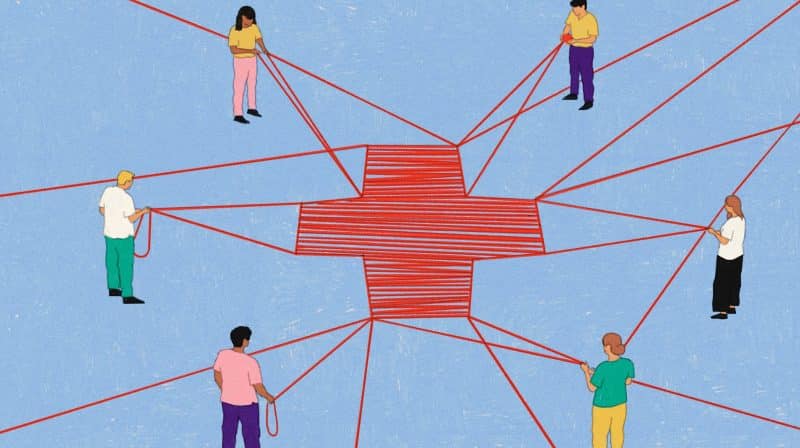
The French Red Cross is equipping volunteers and staff with the tools and methods to build and facilitate their communities, strengthening peer connections, supporting long-term volunteer engagement and enhancing organizational resilience in times of crisis.
Context
When someone joins the French Red Cross, they are not simply joining an organization; they are becoming part of a community of committed volunteers united around a shared purpose: to unconditionally protect and support people in vulnerable situations, and to build resilience alongside them. Yet these communities often exist informally, without a shared framework or methodology to sustain and nurture them over time.
As crises multiply and humanitarian operations grow increasingly complex, the French Red Cross needs strong cross-cutting connections between volunteers, staff, students, partners, and the people it serves. Communities are engines of change; they spark new ideas, enable the sharing of good practices, and allow for rapid, coordinated responses in the face of shocks. Yet without a clear culture of community facilitation, these dynamics end up resting on the shoulders of a few isolated individuals, gradually lose momentum, and remain invisible at the organizational level.
The initiative to build a culture of community facilitation responds to this need by offering a shared framework, a common definition of Red Cross communities, and concrete reference points for facilitation practice. It is structured around five key pillars:
- Purpose and motivation for action,
- Member journey and experience,
- Collective moments and gatherings,
- Active participation,
- Shared culture and values.
By providing a shared language and a clear framework, this model enables facilitators to root their communities in the organization’s core mission, think strategically about member retention, design meaningful rituals, co-create alongside volunteers, and nurture a living, shared culture rather than limiting their efforts to one-off actions.
Who can be a community facilitator and what is their role?
At the French Red Cross, many people are already facilitating a community without necessarily calling it that: local elected representatives, team leaders, thematic focal points, supervisors in residential or care settings… Each of them, in their own way, helps a group of volunteers stay active and connected around a shared cause or common territory.
Framing this reality as a “community” allows us to step back and reflect on their role: understanding that the work lies in creating the conditions for members to feel welcomed, to connect, to act collectively, and to remain engaged over time, and then seeking out the tools and methods to do this in a more structured and sustainable way.
Operations / How It Works
Building a culture of community facilitation within the French Red Cross rests on a structured, step-by-step approach that combines awareness-raising, training, and the provision of practical tools. Concretely, the initiative begins by establishing a shared understanding of what a Red Cross community is: a group of volunteers brought together by a common activity or a shared geographic area, who, through a shared culture and common framework, are collectively able to generate responses that strengthen the resilience of both the people they support and the organization itself. Using a card-based activity, facilitators can gain, in just one hour, a clear understanding of what transforms an active group into a genuine community and explore a set of good practices in community facilitation.
A five-session training programme is then rolled out for community facilitators, covering five core areas: the purpose behind the work, the member journey, collective moments, active participation, and shared culture. Each session offers concrete reference points, proven practices, and ready-to-use tools designed to help facilitators clarify the “why” behind their community, nurture a welcoming environment, support members in taking on greater responsibility, establish meaningful rituals, foster co-creation, and build a cohesive, shared culture.
An internal French Red Cross resource hub provides practical guides, ready-to-use templates (editorial calendars, workshop outlines, onboarding tools, and more), and firsthand accounts from facilitators — all organized around five key development pillars. Facilitators will find concrete, actionable advice on how to communicate with their community, lead group sessions, engage members remotely, and recognize their contributions.
The initiative is led by a central team (the Innovation Department), which develops the content, facilitates training sessions, and oversees its rollout. Staff at the French Red Cross headquarters embed this community-driven culture into their day-to-day support of the network. Gradually, elected representatives and managers carry this momentum forward within local units, delegations, and French Red Cross establishments.
Funding
The Community Facilitation Framework was initially developed with internal funding from the French Red Cross, and subsequently scaled up through co-financing from the European Union as part of its innovation and resilience-building initiatives. These resources enabled the development of the content, the building of the platform, and the delivery of the first rounds of training sessions.
This approach does not generate direct revenue — rather, it represents a strategic investment in volunteer engagement and the organization’s capacity to respond to crises. The underlying ‘business model’ is built on embedding this culture into existing frameworks: training for elected representatives and senior staff, support for local chapters, and equipping teams at the French Red Cross headquarters all without specific charges to local communities.
Deployment / Impact
The culture of community facilitation is being rolled out in phases.
- PHASE 1: BUILDING A SHARED CULTURE AT FRENCH RED CROSS HEADQUARTERS — equipping national-level staff with the tools needed to facilitate stakeholder communities, and encouraging them to embed this approach into their everyday practices.
- PHASE 2: ENGAGING ELECTED REPRESENTATIVES AND SENIOR STAFF—through the integration of dedicated modules into existing training programmes and the development of in-depth workshops.
In parallel, a community facilitation training programme was launched, bringing together facilitators from diverse communities to pilot the content, adapt the tools, and build an initial core group of facilitators.
The impact can be measured at several levels:
- For volunteers, community facilitation strengthens their sense of belonging and long-term engagement: the community becomes a space for mutual support, shared learning, and recognition — rather than simply a channel for information sharing.
- For the organization, the growth of active communities improves the flow of information, accelerates the spread of effective practices, and enhances the capacity to mobilize in times of crisis. At the Movement level, the French Red Cross is developing a framework that other National Societies can adopt — one that positions community facilitation as a genuine driver of resilience.
Opportunities for Collaboration
- This approach may be of interest to other actors working in volunteer mobilization and community resilience, including NGOs, local authorities, community networks, and healthcare or social care institutions. The five-pillar framework and its associated tools can be adapted to strengthen engagement, mutual support, and innovation across a wide range of organizations.
- Conversely, the Movement’s network can continue to enrich this initiative through experience-sharing from other National Societies, the exchange of community facilitation methods, and collaboration on joint training programmes. The broader ambition is to foster, across the Movement as a whole, a shared culture of community facilitation as a driver of resilience in the face of crises.
Key Figures
6
community facilitation training sessions delivered, with approximately 60 French Red Cross staff members trained in community facilitation practices
6
communities supported with more in-depth guidance in developing a tailored strategy
300
elected representatives took part in the community simulation exercise as part of their induction training
Partners and Stakeholders
The French Red Cross was supported by Makesense, a social innovation organisation with strong expertise in community building and engagement, at the launch of the initiative, helping to structure the overall approach and carry out an initial training pilot.
Use Cases / Concrete Examples
To illustrate, in very practical terms, what building a culture of community facilitation can change, a dedicated initiative was carried out with the ERU (Emergency Response Unit) volunteer community. Already highly committed, this community provided an ideal setting to pilot a more structured approach moving away from one-off events toward a sustained, purposeful engagement model built on listening to members, co-designing activities together, and making gradual, informed adjustments along the way.
We began by sending a questionnaire to the entire pool of volunteers in order to gauge their sense of belonging, their participation in collective activities, and their contribution to facilitating the community. The responses revealed a strong sense of pride in being part of the community, but also uneven participation, availability challenges, and differing expectations between newer members and more experienced team members.
A cross-analysis of the findings revealed a set of clear and specific needs: more peer exchange time for experienced staff, more gradual and informal onboarding formats for newcomers, and improved session formats with hybrid options, better communicated in advance to better accommodate everyone’s individual constraints.
Two participatory workshops with community representatives made it possible to co-develop concrete improvements: increasing the frequency of gatherings, introducing informal moments of connection (such as coffee catch-ups and social get-togethers), offering differentiated formats tailored to participants’ varying profiles, and more actively involving team members in the planning and facilitation of activities. These decisions were translated into practical outcomes—for example, a clearer and more accessible schedule, better advance notice for invitations, and a more shared approach to facilitation.
Key Learnings – Advice for another National societies wishing to replicate this solution:
- Start with a clear, shared definition of what a “community” means in your specific context, grounded in your organisational mission and values
- Don’t rely solely on digital tools; invest equally in facilitation skills and practices, and in the thoughtful design of collective spaces and moments
- Roll out in phases, drawing on pilot communities and key allies—such as trainers, managers, and elected leaders—to build credibility and demonstrate impact through concrete examples.
Key Learnings – What would you do differently?
- Dedicate even more time upfront to bringing elected leaders and senior staff on board, so they feel genuine co-ownership of the community facilitation culture, not just supporters of it, but active champions.
- Plan for impact measurement from the very beginning, by defining a small set of straightforward indicators of community vitality early on—such as participation rates, the replicability of tools, and mobilisation capacity in crises
From Idea to Action!
Could all or part of this solution be useful in your own work? You may already be facilitating a community without calling it one. Start by identifying an existing group and consider what makes it a community: a shared purpose, connections between members, collective moments, and opportunities for active participation.
What’s the simplest version of this idea you could test? Choose one community and start by listening to its members. A short survey or a group discussion can be enough to identify what supports engagement, what gets in the way, and one or two community facilitation practices to experiment with.
Who else could you discuss this with? Involve the people who already facilitate the group — team leaders, focal points, elected representatives or staff — but above all, involve its members. Co-creation is an essential part of an active community.