Suwali is a conversational AI (artificial intelligence) platform developed by Meedan, a nonprofit technology organization that builds tools and research to help people access reliable information, exercise their rights and participate in democracy. Suwali helps mission-driven organizations turn their own trusted information into conversations with their communities, and learn from what communities share in return.
Context
Mission-driven organizations have deep, proven expertise on the issues their communities care about most. But too often, that knowledge stays trapped in dense archives, PDFs, buried frequently asked questions pages and the heads of overworked staff.
Meanwhile, the people who need it most may be looking elsewhere, or giving up entirely. When people search for answers online, they have to filter through unreliable sources, algorithm-driven clickbait and misinformation.
Beyond the technology, there is also a deeper human barrier. Many people have sensitive questions they are reluctant to ask another person. They want answers, but they do not want to feel judged, repeat their story or leave a paper trail.

Meedan developed Suwali to address this disconnect. It gives mission-driven organizations a way to make their existing knowledge easier to access through conversational AI, while keeping trusted, community-centered information at the heart of the exchange.
Rather than simply making information available, Suwali creates a two-way conversation: communities can seek answers and share what they know, while organizations can better understand what information people need.
Operations
Suwali is designed to help organizations set up and launch their own conversational AI tool without requiring technical expertise.
Organizations connect Suwali to content they trust and make it available to their audiences through familiar messaging platforms. Community members can then ask questions conversationally and receive answers based on the organization’s approved information.
But most chatbots just answer questions. Suwali is built to keep going, inviting people to share tips, insights and experiences from their daily lives for the organization’s team to review, verify and potentially incorporate into future responses.
Through its dashboard, Suwali surfaces unanswered questions, information gaps and emerging topics across conversations, without compromising users’ privacy.
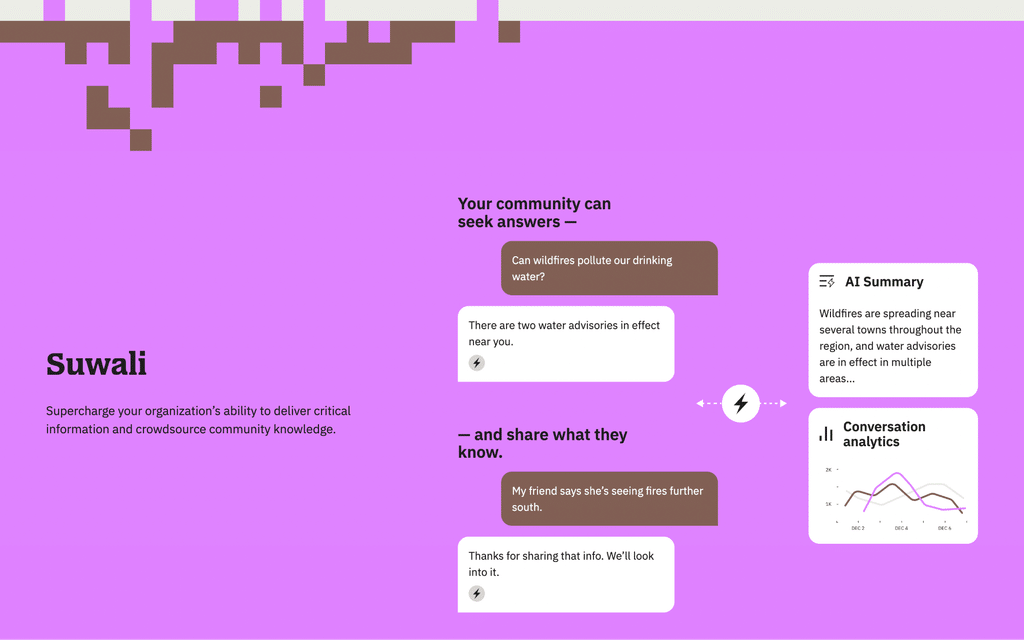
This helps organizations understand what their audiences are asking about, where existing information may be insufficient and what new concerns are emerging.
Organizations can also define what Suwali can answer and when someone should be directed towards human or emergency support. The platform is available through WhatsApp, Telegram and SMS.
Suwali launched in English, Spanish, French and Hindi, with support for Arabic and Portuguese under development.
Funding
The deployment and ongoing research and development of Suwali are backed by global philanthropic foundations and development funds, including the Swedish International Development Cooperation Agency (Sida), Press Forward, the Patrick J. McGovern Foundation, the McNulty Foundation, the National Philanthropic Trust and Battery Powered.
Deployment & Impact
Suwali was built by Meedan over 18 months of product design and engineering to address the disconnect between the information held by public-interest organizations and the people who need it.
Rather than developing a generic tool in isolation, Meedan followed a collaborative, partner-first approach. Suwali was developed alongside pilot organizations working across journalism, health and access to reliable information in Egypt, India, Lebanon and the United States.
The pilot cohort included Deep South Today, Epicenter NYC, The Healthy Indian Project, Al Manassa, Omgyno and The Quint. These organizations tested Suwali in real-world contexts and provided feedback that helped shape the platform around their communities’ needs.
Suwali was publicly launched in April 2026, so evidence of its own long-term social impact is still emerging. However, it builds on Meedan’s wider experience developing technology for the public interest.
Meedan’s global footprint includes:
- 57 countries: Meedan partners with independent media and civil society organizations across 57 countries to promote democratic participation, protect public health and defend human rights.
- 143,631 unique users: In 2025, Meedan’s verification tool Check had 143,631 unique users verifying information during critical events such as elections and natural disasters.
- 34 languages and dialects: Meedan’s tiplines support 34 languages and dialects, helping people access reliable information across different linguistic contexts.
Beyond these figures, Meedan has a dedicated research team that studies ways to reduce online harms and bias in AI, improve how AI models perform across languages and cultures that are often underrepresented, and strengthen the development of AI for the public interest. This work aims to help ensure that technologies such as Suwali remain ethical, equitable and safe, including for vulnerable communities.
Key figures
April 2026
Suwali publicly launched
18 months
of product design and engineering
6 pilot organizations
across Egypt, India, Lebanon and the United States
Partners and stakeholders
Community input has played an important role in Suwali’s development.
Pilot organisations deployed Suwali-powered chatbots with their own audiences and provided feedback on design, language, safety and security. Their input helped Meedan adapt the platform to different local contexts and languages, while keeping the rights and safety of communities at the center.
Use case
Suwali is designed for organizations where trust is not optional.
- Newsrooms can use a Suwali-powered chatbot to turn audience questions into potential story leads and understand what readers actually need to know.
- Health organisations can share verified information in the languages their communities speak and identify misinformation trends.
- Human rights and community organisations can answer questions about elections, legal rights, policy or local governance while hearing directly from communities about what is confusing, missing or wrong.
One of Suwali’s first pilot partners was Omgyno, a social enterprise using digital tools to improve sexual and reproductive healthcare outcomes in Lebanon and Jordan.
Before joining the Suwali pilot, Omgyno explored other options. The organization found that generic AI tools could fall short because they lacked the cultural grounding needed for outreach and communication in the Middle East and North Africa and could not always direct people towards relevant local resources.
Suwali is being developed with this level of specificity at its core.
For Omgyno, the tool also responds to an observable shift in how people seek health information: people increasingly want immediate, conversational answers rather than having to search through articles or navigate clinical language. Developing Arabic-language support is particularly important to making this approach accessible and culturally relevant to the communities Omgyno serves.

Key Learning
For mission-driven organisations exploring the potential of conversational AI, Meedan’s experience highlights a lesson that goes beyond technology alone:
Building the technical infrastructure is only half the journey.
Organisations must prioritise community trust, local context and language. The tool must also fit into the existing workflows of often overstretched teams, while communicating with communities in ways that feel natural and safe.
Suwali is designed to strengthen mission-driven organisations’ ability to share essential information and learn from the knowledge and experiences that communities share in return.
Potential Application
Meedan sees potential applications for public health agencies, civil society organisations, independent media outlets and large regional networks seeking to improve collaboration, information-sharing and community engagement.
For the Red Cross and Red Crescent network, Suwali is an initiative worth paying attention to. As conversational AI continues to develop across the network, it offers a new opportunity to explore how these tools can improve access to reliable information, while helping National Societies listen to, and learn from, the questions, experiences and knowledge emerging from communities.
From idea to action !
Many humanitarian organizations already hold trusted information their communities need — from health and preparedness guidance to service information and frequently asked questions. Suwali shows how conversational AI could make that knowledge easier to access while also helping organizations listen to the questions and information needs emerging from communities.
To adapt it to your context, ask yourself: what trusted information does your organization already have that people struggle to find or understand? Which questions could safely be answered through a conversational tool, and which should always involve a person? Which languages and communication channels would make the information genuinely accessible to your communities?
What’s the smallest version of this idea you could try? Start with one recurring information need and one set of trusted content. Test whether making it conversational helps people find answers more easily, and pay attention to what their questions reveal about missing or unclear information.
Who else could you talk to about this? Bring together the people who manage the information, teams working directly with communities and colleagues responsible for digital tools and data protection. Most importantly, involve community members themselves in deciding what feels useful, understandable and safe.